

Monthly Compliance – February
If you’re in HR, you’re no stranger to compliance management, forms, and deadlines—though keeping them all in order may be a different story. We want to be sure you’re equipped with the right information to keep everything on track throughout the year, from ADA to FLSA.
That’s why we put together the HR Compliance Calendar, to bring you an important list of dates and deadlines you need to know to keep your workplace on track.
In this month’s compliance calendar, you’ll find the key topics to keep your Company up-to-date including employee awareness and required or recommended training.
Register for this Month's Compliance Webinar
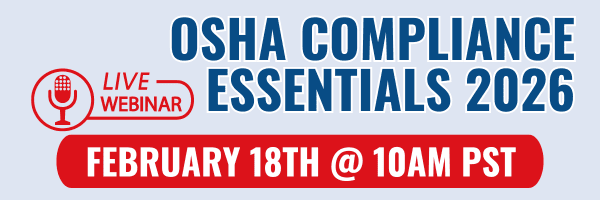
Join Guardian HR for OSHA Compliance Essentials 2026, hosted by Ashley Harges, for a practical, up-to-date walkthrough of what employers need to know to stay compliant and reduce workplace risk in the year ahead. This session will cover key OSHA requirements, common compliance gaps, and the policies, documentation, and practices employers should have in place to protect their teams and their business. You’ll gain clear, actionable guidance you can apply right away — whether you manage a small team or a growing workforce.
Holidays
- President’s Day (George Washington’s Birthday) February 16
Important Dates and Deadlines for this Month
February 1
For certain employers the OSHA 300A must be posted in a conspicuous place visible to all employees i.e., bulletin boards, lunchroom, or near time clock, and must protect employee’s confidential information) from February 1-April 30. The summary must be posted even if there were no recordable injuries or illnesses, and each column total is zero.
- CALIFORNIA EMPLOYERS
- Employers must provide an annual written notice to each current employee that explains certain workers’ protections against unfair immigration-related practices and their constitutional rights when interacting with law enforcement in the workplace. The first notice must be provided on or before February 1, 2026 (see California Workplace - Know Your Rights).
- In addition, employers must, if requested by the employee, notify their designated emergency contact in the event the employee is arrested or detained at work, and employers must give employees an opportunity to designate this emergency contact no later than March 30, 2026(or at the time of hire for employees hired after that date). Guardian HR has prepared a compliant form, For clients with access to the Forms Library see: Hiring > New Hire Packs & Documents > New Hire Packets by State > California > “California Employee Emergency Contact Form”
- COLORADO EMPLOYERS
- Effective February 1, 2026, Colorado’s updated COMPS Order #40, PAY CALC Order, and Wage Protection Rules take effect, revising wage thresholds, clarifying overtime and exemption rules (including for agricultural and highly compensated employees), and aligning recordkeeping and pay practices with the new 2026 minimum wage and salary levels; employers should review the new COMPS, PAY CALC, and Wage Protection Orders and update classifications, pay rates, policies, and required postings accordingly.
- Effective February 1, 2026, Colorado updates certain safety provisions for agricultural workers. Updated agricultural heat‑illness rules require outdoor agricultural worksites to implement heat protections starting at 80°F (including adequate cool drinking water, accessible shade/cool areas, and cool‑down rest breaks), enhanced protections at higher‑risk temperatures, acclimatization measures for new or returning workers during their first hot workdays, and written procedures and training on recognizing and responding to heat illness.
February 22
- NEW YORK CITY EMPLOYERS
- Effective February 22, 2026, New York City expands the permissible uses for paid sick and safe time; requires employers to provide an additional bank of 32 hours of unpaid sick and safe time, officially incorporates additional bank of 20 hours of state paid prenatal leave into local ordinance, and clarifies employers’ obligations in responding to requests for temporary schedule changes.
Topics to Discuss and/or Review
OSHA Recordkeeping and Reporting
- Many employers with more than 10 employees are required to keep a record of serious work-related injuries and illnesses. (Certain low-risk industries are exempted.)
- Employers with 250 or more employees that are subject to OSHA's recordkeeping requirements and employers with 20-249 employees in certain high-risk industries (those listed in appendix A to subpart E of 29 C.F.R. Part 1904) must submit the injury and illness data from Form 300A to OSHA by March 2 of each year.
- Employers with 100 or more employees in certain designated industries (those listed in appendix B to subpart E of 29 C.F.R. Part 1904) are required to electronically submit detailed information about each recordable injury and illness from their OSHA Forms 300 and 301 annually, in addition to data from their Form 300A. These organizations may submit required data for calendar year 2025 beginning January 2, 2026, via OSHA's electronic portal, known as the Injury Tracking Application(ITA). The annual deadline is March 2. OSHA requires an employer to electronically submit its Employer Identification Number (EIN) along with their injury and illness data. Employers must submit injury and illness data via the ITA. The amendments also expand the list of high-risk industries in which employers with 20 or more employees must electronically submit information from their OSHA Form 300A Annual Summary of Work-Related Injuries and Illnesses.
- Minor injuries requiring first aid only do not need to be recorded. Employers should understand that each employer covered by the Occupational Safety and Health Act of 1970 must report to OSHA any workplace incident resulting in a fatality or an inpatient hospitalization. This is a separate requirement than the OSHA 300 reporting requirement.
- Many employers are required to electronically submit information from their Form 300A Summary to OSHA.
- How does OSHA define a recordable injury or illness?
- How does OSHA define first aid?
- The records must be maintained at the worksite for at least five years. Each February through April, employers must post a summary of the injuries and illnesses recorded the previous year. Also, if requested, copies of the records must be provided to current and former employees, or their representatives.
- Employers must report any worker fatality within 8 hours and any amputation, loss of an eye, or hospitalization of a worker within 24 hours.
- OSHA has issued temporary enforcement guidance related to the COVID-19 pandemic for Recording and Reporting Occupational Injuries and Illnesses. See the Regulations and other requirements.
OSHA Recommended Safety and Health Programs
- For clients with access to the Forms Library see: “Occupational Safety and Health Plans by State” located in the Safety > Safety, Disaster & Evacuation Plans & Policies folder
Safety Manual
- Does the Company have to comply & implement with a State required safety program (i.e. Illness and Injury Prevention Program, Accident Prevention Program, Workplace Violence Prevention Program, Heat Illness Prevention Program?
- Is training required under that program?
Safety Team
- For clients with access to the Forms Library see: “Protocols for handling OSHA inspections” located in the Safety > OSHA folder
Safety Meetings
- Designate a subject for each safety meeting like going over the Company’s emergency procedure, heat and illness prevention, any safety regulations specific to the Company’s industry, or discuss workplace violence prevention, safety protection tips etc. to ensure compliance and retention of policies.
Safety Training
Safety Evaluation
- Are there security measures in place? (Access badges, Employee I.D.s, electronic surveillance in work areas, traffic control, security team).
- Are employee’s workplace or is the facility sufficiently lit, are facilities easily accessible for disabled individuals, are employees working in ergonomic positions?
- Are minors prohibited from working in hazardous positions? (Check state law).
- Does the Company have an infectious or communicable disease policy?
Tips
More information in reference to the topics discussed in this month’s compliance calendar can be found in our comprehensive online Forms Library, which is available to members 24/7.